论文总结工具
上传一篇论文,看清它要回答什么问题、怎么研究的、发现了什么(用论文自己的数据),以及作者承认的局限。
看看一篇真实论文能得到什么
三分钟读懂一篇论文
论文总结工具会读完每个章节,帮你判断这篇论文值不值得花一个晚上。
4 个部分 研究问题、研究方法、主要发现和局限,按这个顺序排列
研究问题、研究方法、主要发现和局限,按这个顺序排列
每个数字 照论文原文抄录,并注明去哪个章节核对
照论文原文抄录,并注明去哪个章节核对
每天 3 篇 免费总结论文,无需信用卡
免费总结论文,无需信用卡
看一份真实的论文总结
来自四个领域的四篇开放获取论文,和你的论文一样经过论文总结工具处理。
A large-scale comparison of human-written versus ChatGPT-generated essays
Herbold S, Hautli-Janisz A, Heuer U, Kikteva Z, Trautsch A · Scientific Reports 13, 18617 · 2023
摘要开头
ChatGPT and similar generative AI models have attracted hundreds of millions of users and have become part of the public discourse. Many believe that such models will disrupt society and lead to significant changes in the education system and information generation. So far, this belief is based on either colloquial evidence or benchmarks from the owners of the models—both lack…
阅读原文6
术语
8
记忆卡
5
测验题
This paper presents a large-scale, independent scientific assessment comparing human-written student argumentative essays with essays generated by ChatGPT-3 and ChatGPT-4. Utilizing a fine-grained evaluation rubric scored by 111 secondary school teachers and supported by computational linguistic methods, the study investigates essay quality and linguistic characteristics. The findings demonstrate that ChatGPT-generated essays score significantly higher in quality across all criteria than human-written student essays, with ChatGPT-4 outperforming ChatGPT-3 particularly in logical structure, complexity, and vocabulary richness. Furthermore, the analysis reveals distinct differences in linguistic fingerprints: humans rely more on modal and epistemic constructions, whereas AI models exhibit higher sentence complexity, nominalizations, and rigid structural patterns. The authors conclude that educators must immediately adapt teaching and assessment methods to integrate generative AI tools constructively, treating them similarly to calculators in mathematics education.
论文速览
研究问题
How good is ChatGPT based on GPT-3 and GPT-4 at writing argumentative student essays, how do they compare to student essays, and what linguistic devices characterize each?
研究方法
- Design
- A within-subjects empirical study utilizing zero-shot essay generation and a blind teacher annotation study.
- Data
- 90 argumentative essay topics sourced from an online student writing forum, paired with human-written, ChatGPT-3, and ChatGPT-4 generated essays.
- Sample
- 111 secondary school teachers who rated 270 total essays across seven criteria using a seven-point Likert scale.
- Analysis
- Cronbach's alpha for inter-rater reliability, two-sided Wilcoxon rank-sum tests with Holm-Bonferroni correction, Cohen's d effect sizes, and computational linguistic metrics.
主要发现
- 01
ChatGPT models generate essays rated significantly higher in quality than human-written student essays across all rubric criteria.
Effect sizes for human versus ChatGPT-3 essays were between 0.52 and 1.15; for human versus ChatGPT-4 essays between 0.88 and 1.43.§ Results - 02
ChatGPT-4 significantly outperforms ChatGPT-3 in logical structure, complexity, and vocabulary richness.
Effect sizes between the two models were between 0.45 and 0.5 for logic and composition, vocabulary and text linking, and complexity.§ Results - 03
AI-generated essays exhibit higher sentence complexity and more nominalizations than human essays.
§ Results - 04
Human student essays make significantly more use of modal and epistemic constructions than AI-generated essays.
§ Results
局限(作者自述)
- Neither the student writers nor the teacher raters were English native speakers, potentially affecting generalizability to native speakers.§ Discussion
- The essay topics sourced from an online forum may not be an unbiased, representative sample of all possible essay topics.§ Discussion
- Rapid and opaque updates to generative AI models mean the evaluated versions are moving targets.§ Discussion
未来研究方向
- –Conduct a more systematic study of argumentative structures to understand differences in argumentation between human and AI content.
- –Investigate how the prevalence of AI-generated texts with fewer discourse markers affects human writing habits over time.
论文均为开放获取,采用知识共享(Creative Commons)许可,版权归原作者所有;原文请见链接。总结与工具的输出完全一致,未做任何修改。示例论文是英文的;你自己的论文用什么语言写,总结就用什么语言写。
4 步总结一篇论文
从 PDF 到能核对、能复习、引用时用得上的笔记,几分钟就好。
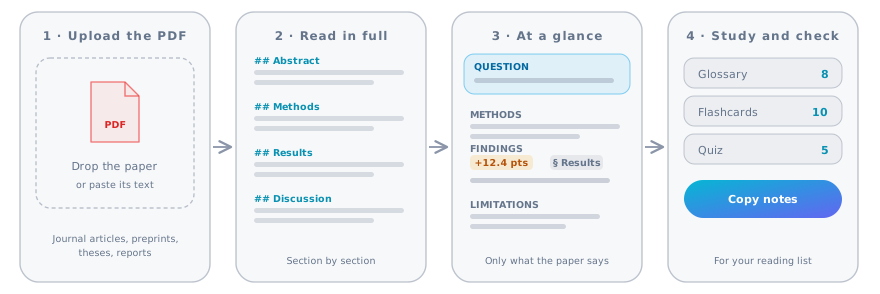
1.上传论文
拖入期刊论文、预印本、学位论文章节或研究报告的 PDF。DOCX 或粘贴文本也可以。
提示
只有链接?先去期刊或预印本页面下载 PDF。
2.完整读完论文
从摘要到讨论,每个章节都会读,不只看第一页。
提示
表格会作为文本,和论文其他部分一起读取。
3.拿到论文速览
论文总结工具列出研究问题、研究方法、带数据的发现,以及作者自述的局限。
提示
每项发现都注明出处章节,比如“结果”或“表 2”。
4.复习并核对
打开章节笔记、术语表、记忆卡和测验,或把笔记复制进你的阅读清单。
提示
打算引用的数字,先回到它注明的章节核对一遍。
论文总结工具会提炼什么
摘要告诉你作者希望你记住什么。总结则把判断一篇论文需要的部分摆在你面前。
研究问题
论文想回答什么,一两句话说清。
研究方法
研究设计、数据、样本量和分析方法,按论文报告的写。
带数字的发现
效应量、百分比和 p 值原样照录,从不四舍五入。
作者自述的局限
作者认为这项研究证明不了什么,以及在哪里说的。
让你能核对,而不只是相信
AI 总结可能略过一句限定条件,也可能读错一张表。所以总结里的每个论断,都告诉你该回原文哪里看。
数字照原文
不四舍五入,不重新计算。论文写 95% CI 1.10–1.83,总结里也是。
每项发现都有出处
结果、方法、表 2:引用之前,你就知道去哪里核对。
不编造批评
局限只来自作者本人。作者一条没写,总结就照实说明。
擅长处理的论文
有问题、有方法、有结果的论文都行。下面这些是大家最常拿来的。
实证研究
实验研究和观察性研究,含样本、效应和 p 值。
临床与健康研究
临床试验和队列研究,结局指标和置信区间完整保留。
机器学习论文
模型、数据集、基准测试,以及真正关键的分数。
综述与 Meta 分析
纳入范围、文献怎么筛选,以及合并结果说明了什么。
硕博学位论文
一次一章,配一份术语表解释领域行话。
预印本
在同行评审之前,快速了解新研究。
拿到总结之后
用论文总结工具处理过的每篇论文,都会以智能笔记的形式存进历史记录。
掌握术语
论文关键术语的术语表,按论文自己的用法来定义。
复习巩固
由同一篇论文生成的记忆卡和小测验,备考、组会读文献都用得上。
听一听
把论文变成一集解说音频,通勤路上听。
读摘要、看 AI 总结,还是读全文?
读一篇论文的三种方式,看你需要了解多少。
| 只读摘要 | AI 总结 | 读全文 | |
|---|---|---|---|
| 时间 | 1 分钟 | 3 分钟 | 1–3 小时 |
| 研究方法 | 最多一句 | 设计、数据、样本、分析 | 全部细节 |
| 数字 | 核心结果 | 每项发现及其数据 | 全部 |
| 局限 | 很少提 | 按作者自述 | 有 |
| 适合 | 决定要不要打开 | 决定要不要细读,以及日后复习 | 引用并在此基础上研究 |
负责任地用 AI 读论文
论文总结工具是阅读辅助。养成这几个习惯,用起来才靠得住。
各套餐的文件大小和每日用量
论文总结工具在所有套餐中都免费。付费套餐支持更大的文件,且没有每日次数限制。
| 套餐 | 最大文件 | 每天论文数 | 每篇记忆卡数 |
|---|---|---|---|
| Free | 100 MB | 3 | 8–10 |
| Starter | 300 MB | 不限 | 30–50 |
| Basic | 300 MB | 不限 | 30–50 |
| Pro、Team、Enterprise | 500 MB | 不限 | 30–50 |
论文总结工具常见问题
学生和研究者最先问的问题,简短回答。