AI podcast tools have split into two distinct camps: platforms for producing shows and tools for converting content into audio you can learn from. TurboCast and Wondercraft both use AI to create podcast-style audio — but for completely different users and completely different reasons.
This comparison breaks down every meaningful difference so you can figure out which one belongs in your workflow.
Quick Overview
🟣 Wondercraft — AI podcast creation platform for producers and marketers. Script or prompt → polished multi-episode shows → distribution to Spotify & Apple Podcasts. Starting at $19/month. No free tier.
🔵 TurboCast — AI podcast generator for learners and researchers. PDF, article, URL, or audio → AI analysis & comprehension → explanatory podcast audio. Free tier available + paid plans from $15/month.
Same category on paper. Completely different in practice.
Feature-by-Feature Comparison
Target Audience
Wondercraft is for podcast creators, marketers, and media teams who want to produce and publish shows at scale — branded podcasts, newsletter audio editions, content marketing operations.
TurboCast is for students, researchers, professionals, and lifelong learners who want to convert existing content into audio. The goal isn't building an audience — it's understanding something faster, or listening while commuting instead of reading at a desk.
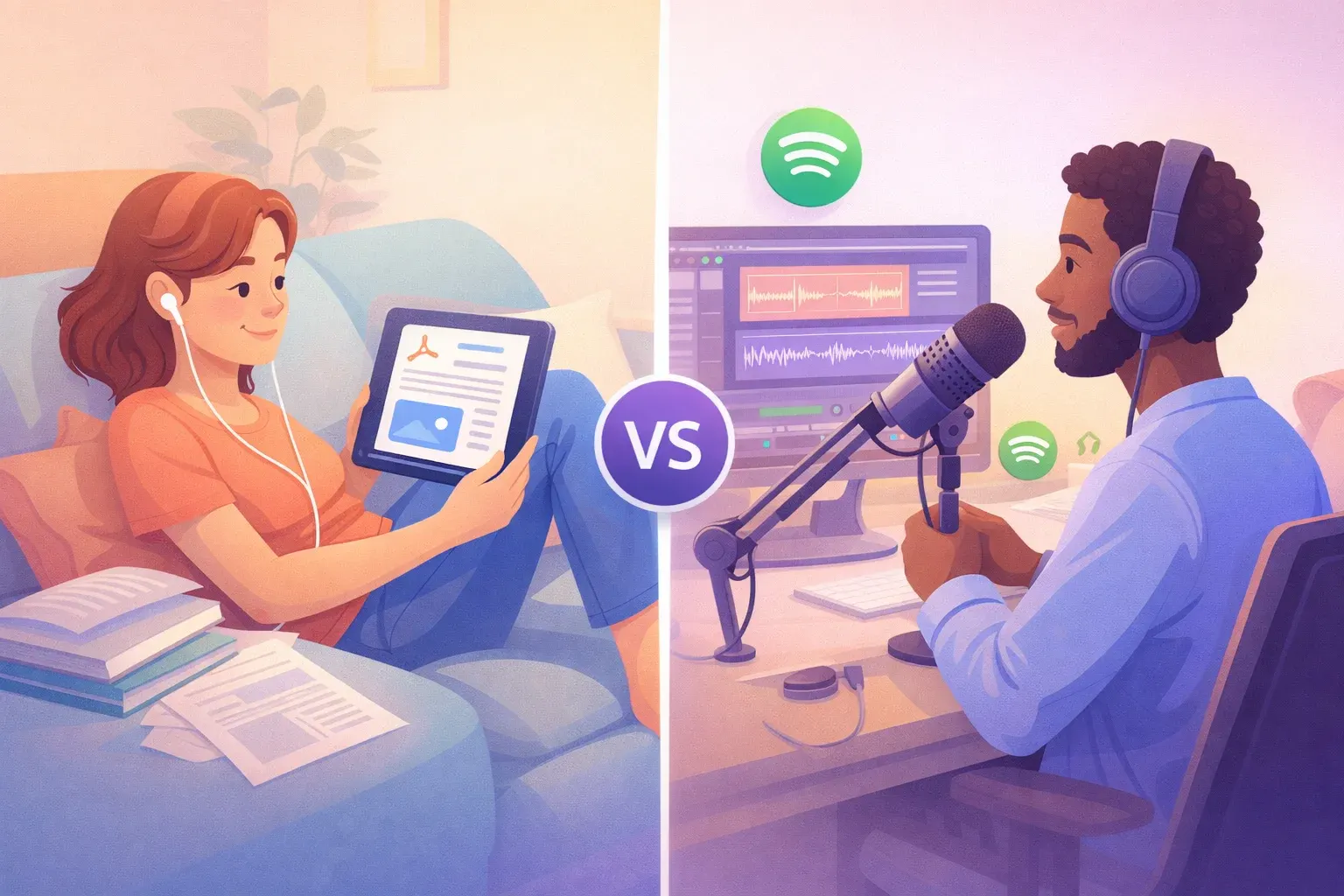
🎯 Key difference: Wondercraft helps you create content for others. TurboCast helps you absorb content for yourself.
Input Types
One of the most meaningful differences between the two.
| Input Type | TurboCast | Wondercraft |
|---|---|---|
| 📄 PDFs | ✅ PDF to podcast | ❌ |
| 🔗 Article URLs | ✅ Article to podcast | ❌ |
| 🎵 Audio/video files | ✅ | ❌ |
| 📝 Plain text | ✅ Text to podcast | ✅ |
| ✍️ Scripts/prompts | ✅ | ✅ |
Bottom line: TurboCast ingests your existing content. Wondercraft needs you to write or prompt the script.
AI Content Understanding
This is where the two tools diverge most sharply.
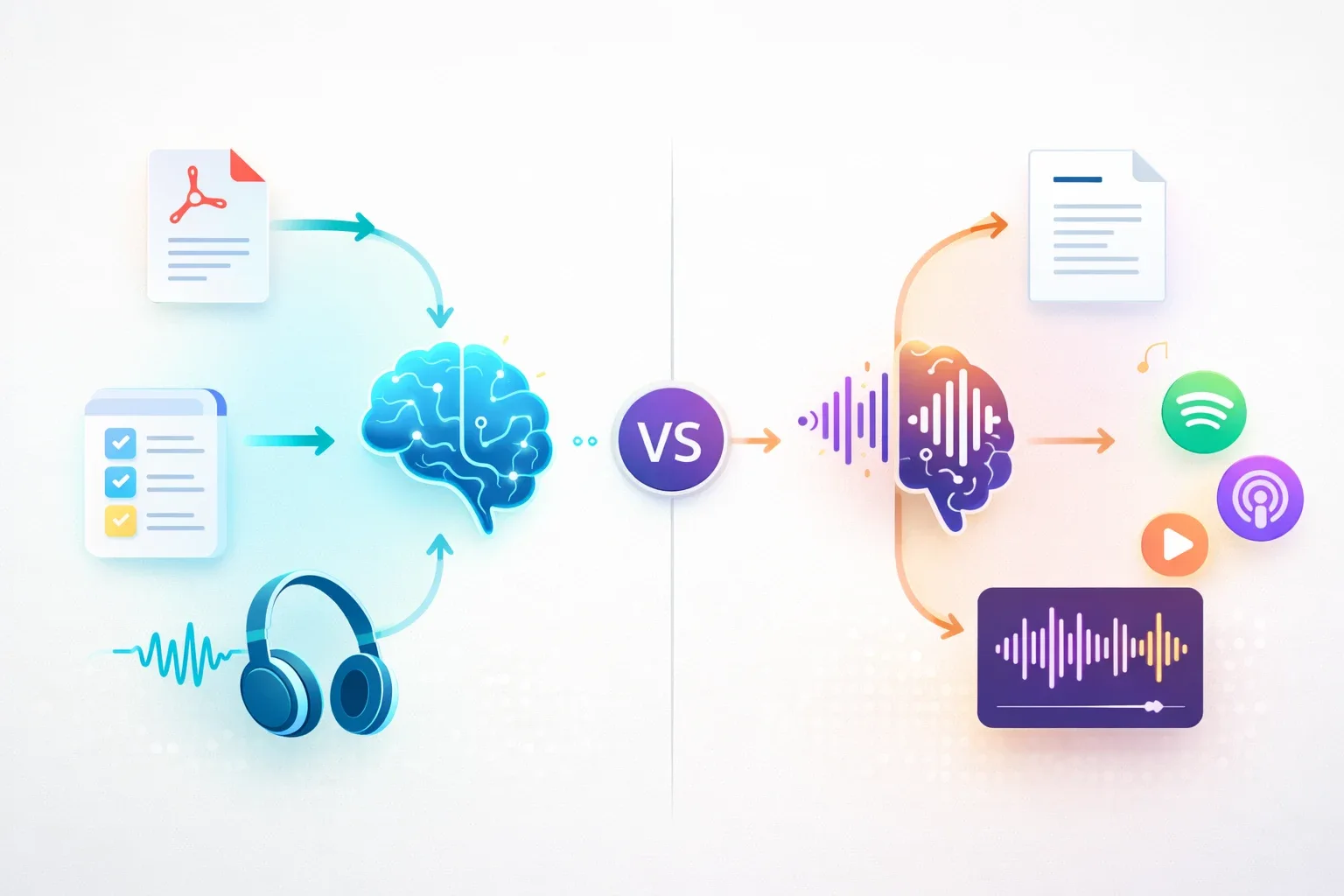
Wondercraft's AI focuses on voice synthesis and episode production. It can generate a script from a prompt, but the content intelligence is shallow — you're expected to know what you want to say.
TurboCast's AI focuses on content comprehension. It reads your source material, identifies key ideas, builds a logical narrative arc, and rewrites everything into a script structured for audio learning. You don't need to understand the content first — that's the whole point.
🧠 Key difference: Wondercraft says it with a good voice. TurboCast understands it first, then explains it clearly.
Output Format
Wondercraft produces podcast episodes ready for distribution — polished, multi-segment shows with intro music, designed for public audiences.
TurboCast produces learning-focused audio explanations with flexible controls:
| Setting | Options |
|---|---|
| 🎙️ Style | Podcast, Teacher, Summary, Storyteller |
| ⏱️ Length | 3 min, 5 min, or 10 min |
| 🌍 Language | 30+ languages |
| 🗣️ Voice | Multiple options across genders and accents |
📋 Key difference: Wondercraft optimizes for entertainment. TurboCast optimizes for comprehension.
Hosting and Distribution
Wondercraft includes built-in podcast hosting with direct distribution to Spotify, Apple Podcasts, and other platforms. For creators building a public audience, this is a genuine time-saver.
TurboCast gives every user a private RSS feed they can subscribe to in any podcast app. Your converted content shows up as a personal podcast in your library — ready to listen on your phone, in your car, or on your run. You can also download individual MP3 files directly.
📡 Key difference: Wondercraft is for public broadcasting. TurboCast is for private listening.
Language Support
Wondercraft supports a limited number of languages, with English as the primary focus.
TurboCast supports 30+ languages for both input and output. Upload a French research paper and get an English explanation. Upload an English article and get a Mandarin podcast. Cross-language conversion happens in one step.
Smart Notes (Summaries & Key Points)
TurboCast includes Smart Notes as a free feature with every conversion — structured summary, key takeaways, and timestamped chapter markers. You get the written digest and the audio together.
Wondercraft doesn't include content analysis features. It's focused purely on audio production.
Pricing Comparison
| Plan | TurboCast | Wondercraft |
|---|---|---|
| Free | ✅ 3 conversions/day | ❌ No free tier |
| Entry | $15/month (300 min) | $19/month |
| Mid | $29/month (600 min) | $49/month |
| Pro | $59/month (1,200 min) | $99/month |
| Team | $79/month (1,800 min) | Custom pricing |
| Annual discount | 20% off | Varies |
What's included free for all TurboCast paid users:
- ✅ Unlimited audio extraction
- ✅ Unlimited transcription (Smart Notes)
- ✅ Private RSS feed
- ✅ Batch upload and export
AI podcast generation uses credits at 1 credit per minute of output. See full pricing details.
Full Comparison Table
| Feature | TurboCast | Wondercraft |
|---|---|---|
| Target user | Learners, researchers, students | Podcast creators, marketers |
| Input: PDFs | ✅ | ❌ |
| Input: Article URLs | ✅ | ❌ |
| Input: Audio/video files | ✅ | ❌ |
| Input: Scripts/prompts | ✅ | ✅ |
| AI content analysis | ⭐ Deep (understands & rewrites) | Surface (voice generation) |
| Output style options | 4 styles | Standard podcast |
| Output length control | 3 / 5 / 10 min | Full episodes |
| Smart Notes | ✅ Free | ❌ |
| Languages | 30+ | Limited |
| Private RSS feed | ✅ | ❌ |
| Public podcast hosting | ❌ | ✅ |
| Distribution to Spotify | ❌ | ✅ |
| Free tier | ✅ | ❌ |
| Starting price | $15/month | $19/month |
When to Choose Wondercraft
You're Building a Branded Podcast
If your goal is to produce and publish regular episodes with AI-generated voices for a public audience, Wondercraft gives you a complete production pipeline.
You Need Direct Spotify/Apple Distribution
Wondercraft's built-in hosting pushes episodes directly to all major podcast platforms — no separate hosting service required.
Your Team Produces Episodes at Scale
Marketing teams running branded podcasts who need consistent volume across episodes will benefit from Wondercraft's production-focused workflow.
When to Choose TurboCast
You Want to Learn from PDFs and Articles
If you're a student with research papers, a professional with long reports, or a researcher with a stack of articles — TurboCast converts all of it into audio explanations without you ever writing a script.
- Convert PDFs to podcast-style audio
- Turn articles and web pages into audio summaries
- Create private audio playlists from your reading list
You Need Multilingual Content Conversion
TurboCast handles cross-language conversion in one step. Upload content in one language, get an AI podcast in another — useful for international students, multilingual teams, and cross-border researchers.
You Want a Free Tier with Real Functionality
TurboCast's free plan gives you 3 conversions per day with no trial expiration. Smart Notes and audio extraction are completely free for paid users.
You Prefer Private Listening over Public Publishing
Every TurboCast user gets a private RSS feed. Your converted content shows up as a personal podcast in your app of choice — no public distribution, just private learning.
The Verdict
| Category | TurboCast | Wondercraft |
|---|---|---|
| Content Understanding | ⭐⭐⭐⭐⭐ | ⭐⭐ |
| Voice Quality | ⭐⭐⭐⭐ | ⭐⭐⭐⭐ |
| Input Flexibility | ⭐⭐⭐⭐⭐ | ⭐⭐ |
| Public Distribution | ⭐⭐ | ⭐⭐⭐⭐⭐ |
| Private Listening | ⭐⭐⭐⭐⭐ | ⭐⭐ |
| Language Support | ⭐⭐⭐⭐⭐ | ⭐⭐⭐ |
| Value for Money | ⭐⭐⭐⭐⭐ | ⭐⭐⭐ |
| Best For | 🎓 Learning & research | 🎙️ Podcast production |
Wondercraft is a podcast production platform for people who want to create and distribute shows. TurboCast is a content conversion tool for people who want to learn from what they already have.
If you're building a podcast → Wondercraft does that well. If you're trying to get through research papers, dense reports, or a backlog of articles → TurboCast was built for exactly that.
Frequently Asked Questions
Can I use TurboCast to create a public podcast?
TurboCast is designed for private listening and personal learning. You get a private RSS feed and MP3 downloads, but it doesn't include public podcast hosting or direct distribution to Spotify. For public podcasts, Wondercraft is the better fit.
Does Wondercraft support PDF or article input?
No. Wondercraft works from scripts and prompts. If you want to convert existing documents, research papers, or articles into audio, you'll need a tool like TurboCast that supports direct content ingestion.
Which tool has better voice quality?
Both tools produce natural-sounding AI voices. Wondercraft focuses on polished, production-ready output. TurboCast focuses on clarity and comprehension. Voice quality is comparable — the real difference is what happens before the voice: whether the AI understands your content or just reads it.
Can I try both tools for free?
TurboCast offers a free tier with 3 conversions per day — no credit card required. Wondercraft does not currently offer a free plan. You can start with TurboCast's free tier at /ai-podcast-generator.
Which is better for students?
TurboCast is built specifically for learning use cases. Upload lecture PDFs, research papers, or course articles and get AI-generated audio explanations. Smart Notes provide summaries and key takeaways for review. The free tier makes it accessible without a subscription.
Try TurboCast free at /ai-podcast-generator. No credit card required. Upload a PDF or paste an article and have your first AI podcast ready in minutes.