논문 요약
논문을 업로드하면 무엇을 묻는지, 어떻게 연구했는지, 무엇을 발견했는지(논문 자체의 수치로), 저자가 인정한 한계까지 알 수 있습니다.
실제 논문에서 무엇을 받는지 확인하세요
논문 한 편을 3분 만에
논문 요약이 모든 섹션을 읽어 주니, 그 논문에 저녁 시간을 쓸 가치가 있는지 판단할 수 있습니다.
4개 파트 연구 질문, 연구 방법, 결과, 한계를 이 순서대로
연구 질문, 연구 방법, 결과, 한계를 이 순서대로
모든 수치 논문에 적힌 그대로 옮기고, 확인할 섹션도 함께
논문에 적힌 그대로 옮기고, 확인할 섹션도 함께
하루 3편 무료로 논문을 요약, 신용카드 불필요
무료로 논문을 요약, 신용카드 불필요
실제 논문 요약 보기
네 분야의 오픈 액세스 논문 4편을, 여러분의 논문과 똑같은 방식으로 논문 요약에 넣었습니다.
A large-scale comparison of human-written versus ChatGPT-generated essays
Herbold S, Hautli-Janisz A, Heuer U, Kikteva Z, Trautsch A · Scientific Reports 13, 18617 · 2023
초록 앞부분
ChatGPT and similar generative AI models have attracted hundreds of millions of users and have become part of the public discourse. Many believe that such models will disrupt society and lead to significant changes in the education system and information generation. So far, this belief is based on either colloquial evidence or benchmarks from the owners of the models—both lack…
원문 읽기6
용어
8
플래시카드
5
퀴즈 문항
This paper presents a large-scale, independent scientific assessment comparing human-written student argumentative essays with essays generated by ChatGPT-3 and ChatGPT-4. Utilizing a fine-grained evaluation rubric scored by 111 secondary school teachers and supported by computational linguistic methods, the study investigates essay quality and linguistic characteristics. The findings demonstrate that ChatGPT-generated essays score significantly higher in quality across all criteria than human-written student essays, with ChatGPT-4 outperforming ChatGPT-3 particularly in logical structure, complexity, and vocabulary richness. Furthermore, the analysis reveals distinct differences in linguistic fingerprints: humans rely more on modal and epistemic constructions, whereas AI models exhibit higher sentence complexity, nominalizations, and rigid structural patterns. The authors conclude that educators must immediately adapt teaching and assessment methods to integrate generative AI tools constructively, treating them similarly to calculators in mathematics education.
한눈에 보는 논문
연구 질문
How good is ChatGPT based on GPT-3 and GPT-4 at writing argumentative student essays, how do they compare to student essays, and what linguistic devices characterize each?
연구 방법
- Design
- A within-subjects empirical study utilizing zero-shot essay generation and a blind teacher annotation study.
- Data
- 90 argumentative essay topics sourced from an online student writing forum, paired with human-written, ChatGPT-3, and ChatGPT-4 generated essays.
- Sample
- 111 secondary school teachers who rated 270 total essays across seven criteria using a seven-point Likert scale.
- Analysis
- Cronbach's alpha for inter-rater reliability, two-sided Wilcoxon rank-sum tests with Holm-Bonferroni correction, Cohen's d effect sizes, and computational linguistic metrics.
주요 결과
- 01
ChatGPT models generate essays rated significantly higher in quality than human-written student essays across all rubric criteria.
Effect sizes for human versus ChatGPT-3 essays were between 0.52 and 1.15; for human versus ChatGPT-4 essays between 0.88 and 1.43.§ Results - 02
ChatGPT-4 significantly outperforms ChatGPT-3 in logical structure, complexity, and vocabulary richness.
Effect sizes between the two models were between 0.45 and 0.5 for logic and composition, vocabulary and text linking, and complexity.§ Results - 03
AI-generated essays exhibit higher sentence complexity and more nominalizations than human essays.
§ Results - 04
Human student essays make significantly more use of modal and epistemic constructions than AI-generated essays.
§ Results
한계(저자가 밝힌 내용)
- Neither the student writers nor the teacher raters were English native speakers, potentially affecting generalizability to native speakers.§ Discussion
- The essay topics sourced from an online forum may not be an unbiased, representative sample of all possible essay topics.§ Discussion
- Rapid and opaque updates to generative AI models mean the evaluated versions are moving targets.§ Discussion
향후 연구
- –Conduct a more systematic study of argumentative structures to understand differences in argumentation between human and AI content.
- –Investigate how the prevalence of AI-generated texts with fewer discourse markers affects human writing habits over time.
논문은 모두 크리에이티브 커먼즈 라이선스의 오픈 액세스 논문이며, 저작권은 저자에게 있습니다. 원문은 링크에서 보세요. 요약은 도구가 내놓은 그대로이며, 전혀 손대지 않았습니다. 샘플 논문은 영어로 쓰였지만, 여러분 논문의 요약은 논문과 같은 언어로 작성됩니다.
4단계로 논문을 요약하는 방법
PDF에서 확인하고, 공부하고, 인용할 때 쓸 수 있는 노트까지 몇 분이면 됩니다.
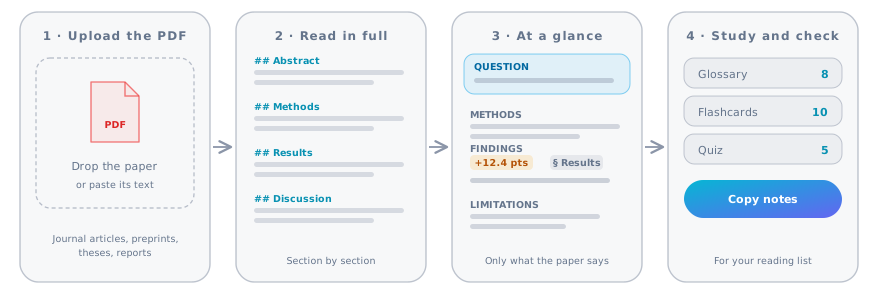
1.논문 업로드
학술지 논문, 프리프린트, 학위논문 챕터, 보고서 PDF를 끌어다 놓으세요. DOCX나 붙여넣은 텍스트도 됩니다.
팁
링크만 있나요? 먼저 학술지나 프리프린트 페이지에서 PDF를 내려받으세요.
2.논문 전체 읽기
첫 페이지만이 아니라 초록부터 고찰까지 모든 섹션을 읽습니다.
팁
표도 본문과 함께 텍스트로 읽습니다.
3.한눈에 보는 논문 받기
논문 요약이 연구 질문, 연구 방법, 수치가 붙은 결과, 저자가 밝힌 한계를 정리합니다.
팁
결과마다 ‘결과’나 ‘표 2’처럼 출처 섹션이 표시됩니다.
4.공부하고 확인하기
섹션별 노트, 용어집, 플래시카드, 퀴즈를 열거나, 노트를 읽기 목록에 복사하세요.
팁
인용할 수치는 표시된 섹션에서 꼭 확인하세요.
논문 요약이 뽑아내는 것
초록은 저자가 기억해 주길 바라는 내용을 알려 줍니다. 요약은 논문을 판단하는 데 필요한 부분을 펼쳐 보입니다.
연구 질문
논문이 답하려 한 질문을 한두 문장으로.
연구 방법
연구 설계, 데이터, 표본 크기, 분석 방법을 논문이 보고한 대로.
수치가 있는 결과
효과 크기, 백분율, p값을 그대로 옮깁니다. 반올림은 하지 않습니다.
저자가 밝힌 한계
이 연구로는 보여 줄 수 없다고 저자가 말한 것, 그리고 그 말이 나온 위치.
믿기만 하지 말고, 확인하도록
AI 요약은 단서 조항을 흘려 넘기거나 표를 잘못 읽을 수 있습니다. 그래서 요약의 모든 주장에 원문 어디를 보면 되는지 붙여 둡니다.
적힌 그대로의 수치
반올림도, 재계산도 하지 않습니다. 논문에 95% CI 1.10–1.83이라고 적혀 있으면 요약도 똑같습니다.
결과마다 출처 섹션
결과, 방법, 표 2: 인용하기 전에 어디서 확인할지 알 수 있습니다.
지어낸 비판 없음
한계는 저자 자신의 것만 적습니다. 저자가 밝힌 한계가 없으면 요약에도 그렇게 씁니다.
잘 처리하는 논문
질문, 방법, 결과가 있는 논문이라면 무엇이든. 가장 많이 들어오는 논문은 이렇습니다.
실증 연구
표본, 효과, p값이 있는 실험 연구와 관찰 연구.
임상·보건 연구
임상시험과 코호트 연구. 결과 지표와 신뢰구간도 그대로.
머신러닝 논문
모델, 데이터셋, 벤치마크, 그리고 중요한 점수.
리뷰와 메타분석
다룬 범위, 연구를 고른 방법, 통합 결과가 말하는 것.
석·박사 학위논문
한 장씩, 분야의 전문 용어는 용어집으로.
프리프린트
동료 심사 전의 새 연구를 빠르게 훑어보기.
요약 후에는
논문 요약으로 처리한 논문은 모두 스마트 노트로 기록에 저장됩니다.
용어 익히기
논문의 핵심 용어를 그 논문에서 쓰는 뜻 그대로 정리한 용어집.
공부하기
같은 논문으로 만든 플래시카드와 짧은 퀴즈. 시험 대비와 저널 클럽에.
귀로 듣기
논문을 내레이션 에피소드로 바꿔 출퇴근길에 들으세요.
초록, AI 요약, 논문 전문 중 무엇을 읽을까?
논문에 들어가는 세 가지 방법. 얼마나 필요한지에 따라 고르세요.
| 초록만 | AI 요약 | 논문 전문 | |
|---|---|---|---|
| 시간 | 1분 | 3분 | 1~3시간 |
| 연구 방법 | 있어도 한 줄 | 설계, 데이터, 표본, 분석 | 모든 세부 사항 |
| 수치 | 대표 결과 하나 | 결과마다 수치와 함께 | 전부 |
| 한계 | 거의 없음 | 저자가 밝힌 대로 | 있음 |
| 적합한 용도 | 열어 볼지 결정 | 정독할지 결정, 나중에 복습 | 인용하고 후속 연구에 활용 |
AI로 논문을 책임감 있게 읽는 법
논문 요약은 읽기를 돕는 도구입니다. 이 습관을 지키면 믿고 쓸 수 있습니다.
플랜별 파일 크기와 하루 사용량
논문 요약은 모든 플랜에서 무료입니다. 유료 플랜은 더 큰 파일을 처리하고 하루 한도가 없습니다.
| 플랜 | 최대 파일 크기 | 하루 논문 수 | 논문당 플래시카드 |
|---|---|---|---|
| Free | 100 MB | 3 | 8~10 |
| Starter | 300 MB | 무제한 | 30~50 |
| Basic | 300 MB | 무제한 | 30~50 |
| Pro, Team, Enterprise | 500 MB | 무제한 | 30~50 |
논문 요약 자주 묻는 질문
학생과 연구자가 가장 먼저 묻는 질문에 짧게 답합니다.