論文要約ツール
論文をアップロードすると、何を問い、どう調べ、何がわかったのか(論文自身の数値で)、そして著者が認める限界まで見えてきます。
実際の論文でどんな結果が出るか見てみる
論文1本を3分で
論文要約ツールがすべてのセクションを読むので、その論文にひと晩かける価値があるかを判断できます。
4つのパート 研究課題・研究方法・知見・限界を、この順番で
研究課題・研究方法・知見・限界を、この順番で
すべての数値 論文の表記どおりに転記し、確認すべきセクションも添えて
論文の表記どおりに転記し、確認すべきセクションも添えて
1日3本 無料で論文を要約、クレジットカード不要
無料で論文を要約、クレジットカード不要
実際の論文要約を見る
4つの分野のオープンアクセス論文4本を、あなたの論文と同じ手順で論文要約ツールにかけました。
A large-scale comparison of human-written versus ChatGPT-generated essays
Herbold S, Hautli-Janisz A, Heuer U, Kikteva Z, Trautsch A · Scientific Reports 13, 18617 · 2023
アブストラクト(冒頭)
ChatGPT and similar generative AI models have attracted hundreds of millions of users and have become part of the public discourse. Many believe that such models will disrupt society and lead to significant changes in the education system and information generation. So far, this belief is based on either colloquial evidence or benchmarks from the owners of the models—both lack…
原文を読む6
用語
8
フラッシュカード
5
クイズ問題
This paper presents a large-scale, independent scientific assessment comparing human-written student argumentative essays with essays generated by ChatGPT-3 and ChatGPT-4. Utilizing a fine-grained evaluation rubric scored by 111 secondary school teachers and supported by computational linguistic methods, the study investigates essay quality and linguistic characteristics. The findings demonstrate that ChatGPT-generated essays score significantly higher in quality across all criteria than human-written student essays, with ChatGPT-4 outperforming ChatGPT-3 particularly in logical structure, complexity, and vocabulary richness. Furthermore, the analysis reveals distinct differences in linguistic fingerprints: humans rely more on modal and epistemic constructions, whereas AI models exhibit higher sentence complexity, nominalizations, and rigid structural patterns. The authors conclude that educators must immediately adapt teaching and assessment methods to integrate generative AI tools constructively, treating them similarly to calculators in mathematics education.
論文のポイント
研究課題
How good is ChatGPT based on GPT-3 and GPT-4 at writing argumentative student essays, how do they compare to student essays, and what linguistic devices characterize each?
研究方法
- Design
- A within-subjects empirical study utilizing zero-shot essay generation and a blind teacher annotation study.
- Data
- 90 argumentative essay topics sourced from an online student writing forum, paired with human-written, ChatGPT-3, and ChatGPT-4 generated essays.
- Sample
- 111 secondary school teachers who rated 270 total essays across seven criteria using a seven-point Likert scale.
- Analysis
- Cronbach's alpha for inter-rater reliability, two-sided Wilcoxon rank-sum tests with Holm-Bonferroni correction, Cohen's d effect sizes, and computational linguistic metrics.
主な知見
- 01
ChatGPT models generate essays rated significantly higher in quality than human-written student essays across all rubric criteria.
Effect sizes for human versus ChatGPT-3 essays were between 0.52 and 1.15; for human versus ChatGPT-4 essays between 0.88 and 1.43.§ Results - 02
ChatGPT-4 significantly outperforms ChatGPT-3 in logical structure, complexity, and vocabulary richness.
Effect sizes between the two models were between 0.45 and 0.5 for logic and composition, vocabulary and text linking, and complexity.§ Results - 03
AI-generated essays exhibit higher sentence complexity and more nominalizations than human essays.
§ Results - 04
Human student essays make significantly more use of modal and epistemic constructions than AI-generated essays.
§ Results
限界(著者による記述)
- Neither the student writers nor the teacher raters were English native speakers, potentially affecting generalizability to native speakers.§ Discussion
- The essay topics sourced from an online forum may not be an unbiased, representative sample of all possible essay topics.§ Discussion
- Rapid and opaque updates to generative AI models mean the evaluated versions are moving targets.§ Discussion
今後の課題
- –Conduct a more systematic study of argumentative structures to understand differences in argumentation between human and AI content.
- –Investigate how the prevalence of AI-generated texts with fewer discourse markers affects human writing habits over time.
論文はいずれもクリエイティブ・コモンズ・ライセンスのオープンアクセス論文で、著作権は著者に帰属します。原文はリンク先でご覧ください。要約はツールが返したまま、一切手を加えずに掲載しています。サンプルの論文は英語ですが、あなたの論文の要約は、論文と同じ言語で作成されます。
4ステップで論文を要約する方法
PDFから、確認でき、学習に使え、引用の手がかりになるノートまで、数分で。
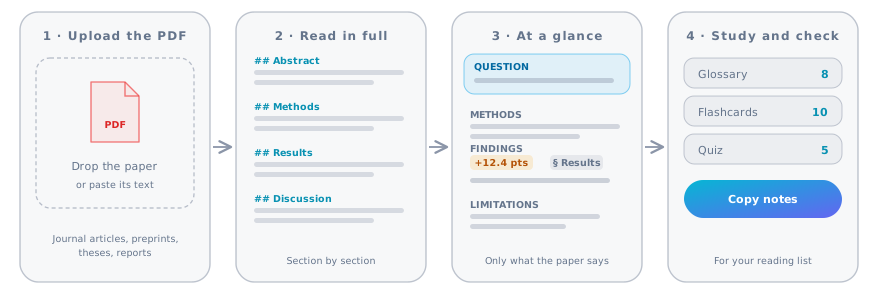
1.論文をアップロード
学術論文、プレプリント、学位論文の章、レポートのPDFをドロップ。DOCXや貼り付けたテキストでもOKです。
ヒント
リンクしかない?先にジャーナルやプレプリントのページからPDFをダウンロードしてください。
2.論文を最後まで読む
最初のページだけでなく、アブストラクトから考察まで、すべてのセクションを読みます。
ヒント
表も、本文と一緒にテキストとして読み取ります。
3.論文のポイントを取得
論文要約ツールが、研究課題、研究方法、数値付きの知見、著者が述べた限界を一覧にします。
ヒント
各知見には「結果」や「表2」など、出典のセクションが付きます。
4.学習して確認
セクションごとのノート、用語集、フラッシュカード、クイズを開くか、ノートを読書リストにコピー。
ヒント
引用する予定の数値は、示されたセクションで必ず確認しましょう。
論文要約ツールが抜き出すもの
アブストラクトは、著者が覚えてほしいことを伝えます。要約は、論文を評価するのに必要な部分を並べます。
研究課題
論文が何に答えようとしたのかを、1〜2文で。
研究方法
研究デザイン、データ、サンプルサイズ、解析方法を、論文の報告どおりに。
数値付きの知見
効果量、割合、p値をそのまま転記。四捨五入はしません。
著者が述べた限界
この研究では示せないと著者が述べていることと、その記述箇所。
鵜呑みにせず、確かめられる設計
AI要約は、但し書きを見落としたり、表を読み違えたりすることがあります。だから要約のすべての記述に、原文のどこを見ればよいかを添えています。
数値は表記どおり
四捨五入も再計算もしません。論文が 95% CI 1.10–1.83 と書いていれば、要約も同じです。
知見ごとにセクション
結果、方法、表2。引用する前に、どこで確認すればよいかがわかります。
批評をでっち上げない
限界は著者自身の記述だけ。記述がなければ、要約にもそう書きます。
得意な論文
問い・方法・結果がそろった論文なら何でも。特によく持ち込まれるのがこちらです。
実証研究
サンプル、効果、p値を含む実験研究や観察研究。
臨床・医療研究
臨床試験やコホート研究。アウトカムと信頼区間もそのまま。
機械学習の論文
モデル、データセット、ベンチマーク、そして肝心のスコア。
レビューとメタアナリシス
対象範囲、研究の選び方、統合した結果が示すこと。
卒論・修論・博論
1章ずつ。分野の専門用語は用語集で。
プレプリント
査読前の新しい研究を、手早く把握。
要約のあとで
論文要約ツールにかけた論文は、すべてスマートノートとして履歴に保存されます。
用語を押さえる
論文の重要用語を、その論文での使われ方に沿って定義した用語集。
学習する
同じ論文から作ったフラッシュカードと短いクイズ。試験にも抄読会にも。
耳で聴く
論文をナレーション付きのエピソードにして、通勤中に。
アブストラクト、AI要約、全文。どれを読む?
論文への3つの入り方。どこまで必要かで選べます。
| アブストラクトのみ | AI要約 | 全文 | |
|---|---|---|---|
| 時間 | 1分 | 3分 | 1〜3時間 |
| 研究方法 | あっても1行 | デザイン、データ、サンプル、解析 | 細部まですべて |
| 数値 | 目玉の結果だけ | 知見ごとに数値付き | すべて |
| 限界 | ほとんど触れない | 著者の記述どおり | あり |
| 向いている用途 | 開くかどうか決める | 精読するか決める、あとで見直す | 引用する、研究の土台にする |
AIで論文を読むときの心得
論文要約ツールは、読むための補助です。次の習慣を守れば、正しく使えます。
プラン別のファイルサイズと1日の利用数
論文要約ツールはどのプランでも無料。有料プランは大きなファイルに対応し、1日の回数制限もありません。
| プラン | 最大ファイルサイズ | 1日の論文数 | 論文1本あたりのフラッシュカード |
|---|---|---|---|
| Free | 100 MB | 3 | 8〜10 |
| Starter | 300 MB | 無制限 | 30〜50 |
| Basic | 300 MB | 無制限 | 30〜50 |
| Pro、Team、Enterprise | 500 MB | 無制限 | 30〜50 |
論文要約ツールのよくある質問
学生や研究者がまず聞くことに、短く答えます。