
Research Paper Summarizer
Upload a paper and get the question it asks, how it was studied, what it found with the paper's own numbers, and the limits the authors admit.
See what you get from a real paper
A Paper in Three Minutes
The research paper summarizer reads every section, so you can decide whether the paper deserves an evening.
4 parts research question, methods, findings and limitations, in that order
research question, methods, findings and limitations, in that order
Every number copied as the paper writes it, with the section to check it in
copied as the paper writes it, with the section to check it in
3 a day free paper summaries, no card needed
free paper summaries, no card needed
See a Real Paper Summary
Four open-access papers from four fields, run through the research paper summarizer the same way yours would be.
A large-scale comparison of human-written versus ChatGPT-generated essays
Herbold S, Hautli-Janisz A, Heuer U, Kikteva Z, Trautsch A · Scientific Reports 13, 18617 · 2023
Abstract, opening
ChatGPT and similar generative AI models have attracted hundreds of millions of users and have become part of the public discourse. Many believe that such models will disrupt society and lead to significant changes in the education system and information generation. So far, this belief is based on either colloquial evidence or benchmarks from the owners of the models—both lack…
Read the original6
glossary terms
8
flashcards
5
quiz questions
This paper presents a large-scale, independent scientific assessment comparing human-written student argumentative essays with essays generated by ChatGPT-3 and ChatGPT-4. Utilizing a fine-grained evaluation rubric scored by 111 secondary school teachers and supported by computational linguistic methods, the study investigates essay quality and linguistic characteristics. The findings demonstrate that ChatGPT-generated essays score significantly higher in quality across all criteria than human-written student essays, with ChatGPT-4 outperforming ChatGPT-3 particularly in logical structure, complexity, and vocabulary richness. Furthermore, the analysis reveals distinct differences in linguistic fingerprints: humans rely more on modal and epistemic constructions, whereas AI models exhibit higher sentence complexity, nominalizations, and rigid structural patterns. The authors conclude that educators must immediately adapt teaching and assessment methods to integrate generative AI tools constructively, treating them similarly to calculators in mathematics education.
Paper at a glance
Research question
How good is ChatGPT based on GPT-3 and GPT-4 at writing argumentative student essays, how do they compare to student essays, and what linguistic devices characterize each?
Methods
- Design
- A within-subjects empirical study utilizing zero-shot essay generation and a blind teacher annotation study.
- Data
- 90 argumentative essay topics sourced from an online student writing forum, paired with human-written, ChatGPT-3, and ChatGPT-4 generated essays.
- Sample
- 111 secondary school teachers who rated 270 total essays across seven criteria using a seven-point Likert scale.
- Analysis
- Cronbach's alpha for inter-rater reliability, two-sided Wilcoxon rank-sum tests with Holm-Bonferroni correction, Cohen's d effect sizes, and computational linguistic metrics.
Key findings
- 01
ChatGPT models generate essays rated significantly higher in quality than human-written student essays across all rubric criteria.
Effect sizes for human versus ChatGPT-3 essays were between 0.52 and 1.15; for human versus ChatGPT-4 essays between 0.88 and 1.43.§ Results - 02
ChatGPT-4 significantly outperforms ChatGPT-3 in logical structure, complexity, and vocabulary richness.
Effect sizes between the two models were between 0.45 and 0.5 for logic and composition, vocabulary and text linking, and complexity.§ Results - 03
AI-generated essays exhibit higher sentence complexity and more nominalizations than human essays.
§ Results - 04
Human student essays make significantly more use of modal and epistemic constructions than AI-generated essays.
§ Results
Limitations (stated by the authors)
- Neither the student writers nor the teacher raters were English native speakers, potentially affecting generalizability to native speakers.§ Discussion
- The essay topics sourced from an online forum may not be an unbiased, representative sample of all possible essay topics.§ Discussion
- Rapid and opaque updates to generative AI models mean the evaluated versions are moving targets.§ Discussion
Future work
- –Conduct a more systematic study of argumentative structures to understand differences in argumentation between human and AI content.
- –Investigate how the prevalence of AI-generated texts with fewer discourse markers affects human writing habits over time.
The papers are open access under Creative Commons licences and belong to their authors; follow the links for the originals. The summaries are shown exactly as the research paper summarizer returned them.
How to Summarize a Research Paper in 4 Steps
From PDF to notes you can check, study and cite from in a couple of minutes.
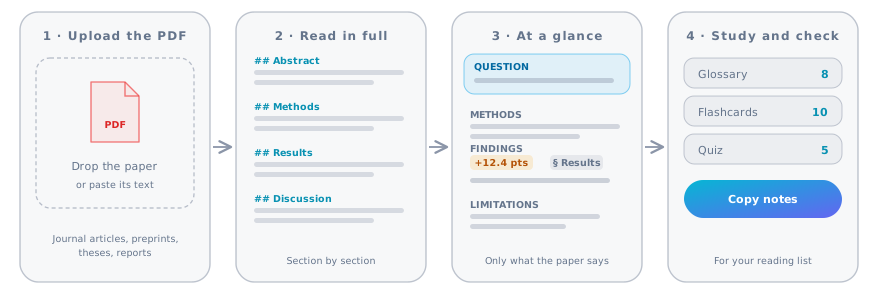
1.Upload the paper
Drop the PDF of a journal article, preprint, thesis chapter or report. A DOCX or pasted text works too.
Tip
Only have a link? Download the PDF from the journal or preprint page first.
2.It reads the whole paper
Every section is read, from the abstract to the discussion, not just the first page.
Tip
Tables are read as text along with the rest of the paper.
3.Get the paper at a glance
The research paper summarizer lists the question, the methods, the findings with their numbers and the authors' limitations.
Tip
Each finding names its section, like Results or Table 2.
4.Study and check
Open the section notes, glossary, flashcards and quiz, or copy the notes into your reading list.
Tip
Check any number you plan to quote against the section it names.
What the Research Paper Summarizer Pulls Out
An abstract tells you what the authors want you to remember. The summary lays out the parts you need to judge the paper.
The research question
What the paper set out to answer, in one or two sentences.
The methods
Design, data, sample size and analysis, as the paper reports them.
Findings with numbers
Effect sizes, percentages and p-values copied exactly, never rounded.
The authors' limitations
What the authors say their study can't show, and where they say it.
Built to Be Checked, Not Just Trusted
AI summaries can smooth over a caveat or misread a table. So every claim in the summary tells you where to look in the original.
Numbers as written
No rounding, no recomputing. If the paper says 95% CI 1.10–1.83, so does the summary.
A section for every finding
Results, Methods, Table 2: you know where to check before you quote it.
No made-up critique
Limitations are the authors' own. If they state none, the summary says so.
Papers It Handles Well
Any paper with a question, a method and results. These are the ones people bring most.
Empirical studies
Experiments and observational studies with samples, effects and p-values.
Clinical and health research
Trials and cohort studies, with outcomes and confidence intervals intact.
Machine learning papers
The model, the datasets, the benchmarks and the scores that matter.
Reviews and meta-analyses
The scope, how studies were picked and what the pooled results say.
Theses and dissertations
One chapter at a time, with a glossary for the field's jargon.
Preprints
A quick read on new work before it has been peer reviewed.
After the Summary
Every paper you run through the research paper summarizer is saved in your History as Smart Notes.
Learn the vocabulary
A glossary of the paper's key terms, defined the way the paper uses them.
Study it
Flashcards and a short quiz made from the same paper, for exams and journal clubs.
Listen to it
Turn the paper into a narrated episode for the commute.
Abstract, AI Summary or the Full Paper?
Three ways into a paper, depending on how much you need from it.
| Abstract only | AI summary | Full paper | |
|---|---|---|---|
| Time | 1 minute | 3 minutes | 1–3 hours |
| Methods | One line, if any | Design, data, sample, analysis | Every detail |
| Numbers | The headline result | Each finding with its numbers | All of them |
| Limitations | Rarely | As the authors state them | |
| Best for | Deciding to open it | Deciding to read it, and reviewing it later | Citing and building on it |
How to Read Papers With AI, Responsibly
A research paper summarizer is a reading aid. These habits keep it honest.
File Size and Daily Use by Plan
The research paper summarizer is free on every plan. Paid plans take bigger files and have no daily limit.
| Plan | Largest file | Papers per day | Flashcards per paper |
|---|---|---|---|
| Free | 100 MB | 3 | 8–10 |
| Starter | 300 MB | Unlimited | 30–50 |
| Basic | 300 MB | Unlimited | 30–50 |
| Pro, Team, Enterprise | 500 MB | Unlimited | 30–50 |
Research Paper Summarizer FAQ
Short answers to what students and researchers ask first.

Summarize Your Next Paper
Upload the PDF and get the question, the methods, the findings and the limitations in a couple of minutes. Free for 3 papers a day.